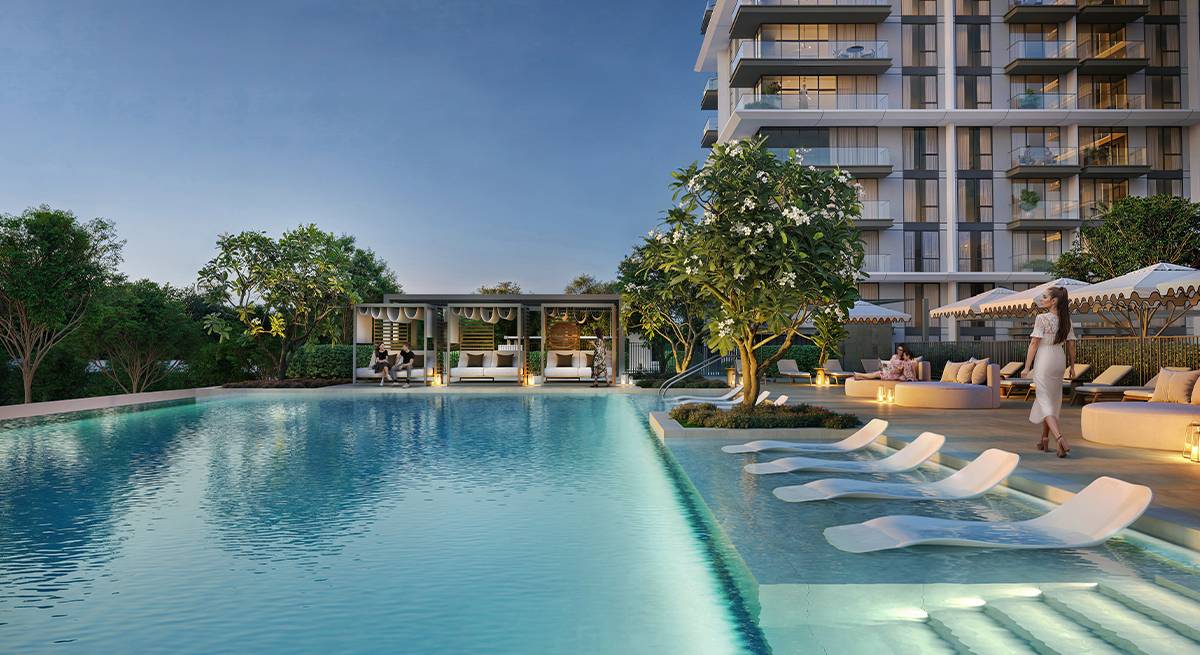
What a branded residence is, what the premium buys, running costs, rental programmes, what happens if the brand leaves, and how to assess one before buying.
In this guide
A branded residence is a home sold under the name of an established brand, most often a hotel operator, increasingly a car maker, fashion house or sports club. You pay more for it: Betterhomes put the premium in Dubai at about 40% in March 2026. What you get for the premium varies from a fully serviced building run by a hotel company to little more than a logo and a design theme. The brand does not build the homes and can leave. This guide explains how the arrangements work, what they cost to own, and how to test whether a particular project is worth its price.
What is a branded residence?
There are three parties: the developer, who buys the land, builds, sells and is responsible for delivery; the brand, which lends its name and standards under a contract; and the owners, who buy individual homes and pay the running costs. The buyer's contract is with the developer. The buyer usually has no contract with the brand.
Two broad models exist, and the difference matters more than the name on the door.
| Operator-managed | Licensed (name and design) | |
|---|---|---|
| Typical brand | Hotel companies | Car makers, fashion and jewellery houses, sports clubs, cultural institutions |
| UAE examples | Four Seasons Private Residences in Abu Dhabi; Aman Residences in Dubai; Cheval South Bay in Dubai South | Bugatti Residences, Mercedes-Benz Places and Burj Binghatti Jacob & Co. Residences in Dubai; Manchester City Yas Residences and Louvre Abu Dhabi Residences in Abu Dhabi |
| What the brand does | Staffs and runs the building, often next to or above its hotel; may run a rental programme | Approves design and marketing; day-to-day management is usually by a separate company |
| What to ask | How long is the management agreement and what does it cost owners each year? | Who manages the building after handover, and to what standard? |
Some projects are harder to place. Betterhomes names Armani Beach Residences among Dubai's upcoming schemes; whether a fashion-led project is run by a hotel operator or simply carries a licensed name has to be established project by project.
How big is the UAE branded residence market?
Knight Frank's Destination Dubai report (May 2025) describes Dubai as the global leader in branded residences. Betterhomes reported in March 2026 that the global sector had grown 160% in a decade and that Dubai had more than 140 branded developments due for delivery by 2031. That is a large pipeline for a product sold on scarcity.
Recent data points from named sources:
- Dubai. An apartment at Aman Residences sold for AED 166 million in Q3 2026 (Savills). Cheval Collection announced Cheval South Bay on 11 November 2026: 98 serviced hotel apartments and 95 branded residences in Dubai South, with sales expected to start in 2027 and opening scheduled for 2030 (The National).
- Abu Dhabi. Manchester City Yas Residences on Yas Island generated AED 6 billion of sales within 72 hours of its mid-February 2026 launch, according to Savills (reported by Semafor). CBRE's Q1 2026 review recorded the highest price in the emirate at Four Seasons Private Residences, above AED 86,000 per sq m, which is roughly AED 8,000 per sq ft. Aldar expected to hand over Louvre Abu Dhabi Residences on Saadiyat Island during 2026 (The National); Betterhomes quoted about AED 3 million for a one-bedroom there in October 2026.
- Ras Al Khaimah. RAK Properties plans to release Four Seasons-branded residences and a hotel in the first half of 2027 (Khaleej Times). Hotel brands arriving alongside the Wynn resort include Nobu and Janu (The National).
Knight Frank and Savills also publish global research on branded-residence premiums. We quote only figures we were able to check at source, so their premium estimates are not repeated here.
How much more do branded residences cost?
Betterhomes' figure for Dubai is about 40%. It does not publish the comparison base, and a single average hides a wide range. A premium figure can also flatter the brand: branded schemes tend to be newer, better located and more highly specified than the average home around them, so part of the "brand premium" is really a location and quality premium.
A better test is one you can run yourself. Take the asking price per square foot of the branded home and compare it with registered sales of similar non-branded homes in the same district over the past year, using Dubai Land Department records. As a scale check, CBRE's figure of roughly AED 8,000 per sq ft for Four Seasons Private Residences in Abu Dhabi compares with Bayut's Q3 2026 average asking price of AED 2,732 per sq ft for apartments on Saadiyat Island, the most expensive district in its Abu Dhabi report alongside The Marina.
What the premium does to rental yield
A higher price needs a proportionately higher rent. The figures below are our illustration, not market data.
| Non-branded apartment | Branded equivalent (40% premium) | |
|---|---|---|
| Price | AED 3,000,000 | AED 4,200,000 |
| Annual rent | AED 150,000 | AED 180,000 (20% higher) |
| Gross yield | 5.0% | 4.3% |
| Service charge on 1,200 sq ft | AED 24,000 (AED 20 per sq ft) | AED 42,000 (AED 35 per sq ft) |
| Income after service charge | AED 126,000 | AED 138,000 |
| Yield after service charge | 4.2% | 3.3% |
To match the non-branded home's 5.0% gross yield, the branded one would need AED 210,000 in rent, 40% more. Prime yields are already low: Bayut's Q3 2026 listing data shows 4.4% gross for Palm Jumeirah apartments and 4.6% for Saadiyat Island. On these numbers a branded home is hard to justify on rental income alone. Use the rental yield calculator with the real figures for the unit you are considering.
Running costs and service charges
Expect a branded building to cost more to run than a standard one, and check the figure instead of assuming it. The reasons are practical: more staff per home, concierge and valet services, larger shared amenities, and the brand's operating standards for cleaning, maintenance and replacement.
- Service charge. In Dubai, the Real Estate Regulatory Agency approves each project's service charge, and the approved figure for any project and year is published in the Dubai Land Department's free Service Charge Index. Look up the branded building, or the developer's nearest completed equivalent, and a non-branded neighbour. Our service charges guide explains what the charge covers.
- Brand and management fees. Ask whether the brand's licence fee or the operator's management fee is recovered from owners through the service charge, and how it is calculated.
- Furniture and refurbishment. Homes in a rental programme must usually meet the brand's furnishing standard, with periodic replacement at the owner's cost.
- Pay-per-use services. Housekeeping, in-residence dining and similar services are normally charged separately.
For an off-plan purchase the service charge is an estimate until the building is running. Ask for it in writing and treat it as a minimum.
Rental pools and management arrangements
An owner typically has three options.
- Let it yourself on a long lease. A normal 12-month tenancy through an agent. The tenant pays for the address and the facilities.
- Join the operator's rental programme. The operator markets the home as short-stay accommodation and shares the revenue with you. Check the split, which costs are deducted first, how many nights you may use the home, the minimum commitment and how you leave the programme.
- Run it as a holiday home. In Dubai this needs a permit from the Department of Economy and Tourism for each unit. Units in hotel-apartment buildings cannot be operated as holiday homes by their owners (Bayut, October 2026), which can leave the operator's programme as the only short-let route.
Ask for the programme's actual occupancy and net payments to owners over the past two years, for a comparable unit. Where a developer advertises a fixed return or a rental guarantee, find out who pays it, for how long and from what, and what the home would earn without it. Short-stay income moves with tourism: CBRE reported Dubai hotel occupancy at about 23% in the week ending 14 March 2026, after the regional conflict began.
What happens if the brand leaves?
Brand agreements run for a fixed term and can end early. A brand can withdraw if standards slip or fees go unpaid; a developer or management entity can decline to renew; a brand can be sold or change strategy. If it happens, the name comes off the building, branded staff and booking systems may go with it, and the home is valued as what it physically is.
Before buying, ask the developer in writing:
- Who are the parties to the brand agreement, and what is its term from handover?
- What are the renewal and termination provisions on each side?
- Do owners have any vote or consultation right?
- Which services are delivered by the brand's own staff and which by contractors?
- If the agreement ends, who manages the building and what happens to the service charge?
If the answers are vague, price the home as if it were unbranded.
How to assess a branded residence
- Start with the developer. The delivery record of the developer matters more than the fame of the brand. Check completed projects on our developers pages and read the off-plan guide.
- Identify the model. Operator-managed or licensed, and which company runs the building day to day.
- Measure the premium against registered sales nearby, per square foot.
- Look up or obtain the service charge and model the net yield.
- Read the brand agreement terms listed above.
- Count the competition. With more than 140 schemes due in Dubai by 2031, ask how many branded homes will complete in the same district at the same time.
- Check the handover date. Projects announced in 2026 are scheduled as far out as 2030. The brand's standing and the market may both look different by then.
The market context in late 2026
The top of the Dubai market has cooled. Knight Frank reported that prices across ten prime neighbourhoods fell 5% in Q3 2026 against Q2, the first fall since 2020, and that sales of homes above US$10 million fell 17% year on year in the quarter, although the year-to-date count was still 15% ahead of 2025. S&P Global Ratings has said the conflict's greatest effect may fall on luxury and ultra-luxury demand, and UBS expects uncertainty over wealthy arrivals to weigh on the premium segment. Abu Dhabi's high-end launches sold strongly in the first half of 2026.
For a buyer the point is simple: a brand premium is the part of the price most exposed if sentiment weakens further, and a cooler market is the time to ask harder questions and to negotiate. The wider picture is in Is Dubai property a good investment?. Current branded projects are listed under developments.